Features in the Gallery: Looking at the Big Picture

This image from 2008-12-10 09:39:28 is pretty interesting…

SkyView COMPTEL image

It looks like we are seeing some very special object with rings around it. What’s going on here?

This is a COMPTEL image, one of the lowest resolution surveys we have in SkyView. It’s taken in the hard X-ray/Soft gamma ray regime where it’s very difficult to build an imaging detector at all. The method used requires a complex deconvolution and yields at best a resolution of a few degrees. So the pixels are very large and the image would – absent distortions – cover almost the entire sky. However, you can’t project such a large region of the sky onto a single plane image without very large distortions. In fact the default projection that SkyView uses, the Tangent plane or Gnomonic projection, only shows half the sky no matter how big we make our image. The great circle 90 degrees from the center of the field of view is off at infinity. It’s rather like the way Mercator maps get enormously distorted as you near the poles — and even so you can never quite get there.

The middle of the image is reasonable enough, but as we approach the edges pixels are being stretched out in a radially symmetric pattern.

Another projection can show the whole sky in a more understandable fashion. One might try an Aitoff or Cartesian projection if you know that you want to see the entire sky. However if you want to make sure that a given point is at the center of the map, then something like the ZEA (for Zenithal Equal Area) projection might be nice. Here we’ve redone the picture in that projection:

Comptel data: ZEA projection

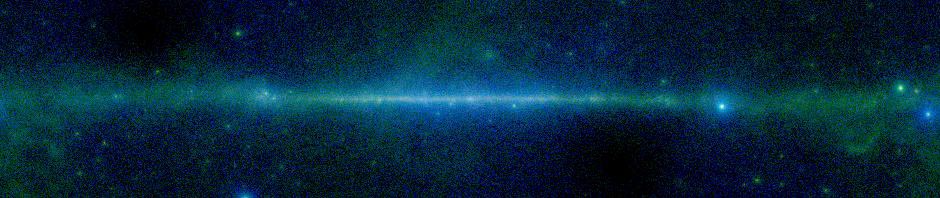
The entire sky is shown here with the point opposite the requested center forming an infinitesimally thin ring around the image. So it is still distorted, but in a way that doesn’t obscure the global features as much. Every pixel represents the same area in the sky. The plane of our Galaxy shows up clearly as a circle of enhanced emission and the bright spot is the Crab nebula.

The lesson here is that you need to adapt your projection to the application. Some projections, e.g., the Tangent or Sine projections just won’t do very well for large fields of view. Others, e.g., the Cartesian projection near the pole, can be a poor choice when looking at a particular small region of the sky.

Posted in Discussion | Tagged , , | 1 Comment

Features in the Gallery: Worms in Space

This image from 2008-12-06 15:57:53

DSS image

shows a very interesting feature that looks like a giant worm squirming amongst the stars. In fact it’s actually a tiny hair that got on the photographic plate sometime in the process of taking, developing or scanning the image.

How can we tell that this isn’t Nobel-Prize-winning stuff? The obvious giveaway is how thin the feature is. The stars in the image are point sources blurred by optical limits, telescope jitter, and especially seeing. Any real astronomical source can be no sharper than they. Our worm is much thinner.

Hairs and dust show up occasionally on all of the surveys scanned from optical plates.

Posted in Discussion | Tagged , , | 2 Comments

SkyView GALEX GR4: Off center images fixed.

A new version of SkyView has been installed to accommodate the issues that off center GALEX GR4 images presented. GALEX now uses a special GalexExposure Image finder. This uses knowledge of the GALEX survey to find the center of the actual field of view for every observation. Specifically it looks for the AVASPRA and AVASPDEC keywords in the header and uses the pixel location corresponding to these coordinates as the center of the field of view. The center locations in the survey description file have also been updated to use the FOV centers rather than the nominal image centers.

Posted in Notices | Tagged , | Leave a comment

Features in the Gallery: Very Bright Stars

Lots of people are using the Image gallery. One popular theme is to find images that look very peculiar. E.g., look at the image in the gallery from 2008-11-29 19:02:44

Gallery: 2008-11-29 19:02:44

This is a very peculiar looking field in the DSS. It looks very pixelated, but it’s a normal sized image so the pixels are much larger than the actual image pixels. There are few if any stars visible? What’s going on?

We can find out by zooming out and doing a full square degree region around the same center: 101.35626366727445,-16.713875539779025. This gives us the image we see at 2008-12-01 16:59:43 in the gallery.

Gallery: 2008-12-01 16:59:43

The image is actually the center of a massive burnt out region in the underlying photographic plate. We’re looking at Sirius! A big (40″) telescope, extremely sensitive emulsion and long exposure don’t mix well with the brightest star in the sky. The scattered light from Sirius is still affecting the data over this entire square degree but at least at this scale we can see the cause and at the edges we can begin to pick up other objects in the field. So don’t expect to see very bright stars in most of the optical surveys. They are a billion times brighter than the objects that these surveys were intended to detect.

Posted in Discussion | Tagged , , , | Leave a comment

Unexpected image offsets in the GALEX GR4

The underlying GALEX observations used in SkyView are 3840×3840 pixel images where only a circle with a radius of about 2900 pixels is actually exposed. In earlier releases the exposed region seemed to be centered with the image square but that is no longer always the case for GR4. The observation center can now be hundreds of pixels offset from the nominal image center.

SkyView tries to mask out the non-observed reqion when it combines GALEX observations, but when the mask is off-center this masking may go awry. We’re downloading information from MAST giving the actual centers for the observations rather than the nominal image centers and we will update the survey description file for MAST appropriately within the next few days to accommodate this, but in the meantime GR4 images may show unexpected blank patches.

CLI users of SkyView can play with the image finder setting to try to mitigate this, but this is unlikely to help in most cases.

Posted in Notices | Tagged , | Leave a comment

SkyView 2MASS data back online

The 2MASS survey data are available again via SkyView.

Posted in Notices | Tagged , | Leave a comment

SkyView SDSS and 2MASS data availability

The SDSS server connection problems that were reported earlier this week have been resolved. However again due to connection problems with the remote system that provides the data, 2MASS survey data are unavailable via SkyView. We have been in touch with personnel at IPAC and hope to have the connection issues resolved soon. We apologize for the inconvenience.

Posted in Notices | Tagged , , | Leave a comment

SkyView SDSS data are unavailable

Sloan Digitized Sky Survey images are not available at this time due to problems connecting to the remote server that hosts the SDSS data. We are investigating the problem and apologize for any inconvenience.

Posted in Notices | Tagged | Leave a comment

More SkyView LogLog scaling

The LogLog scaling that was the subject of a previous post has been added to the SkyView Query Form. Look for it as a Brightness Scaling option in the Other Options section.

Posted in releases | Tagged , | Leave a comment

SkyView at the IVOA: SAMP

Last week the semi-annual International Virtual Observation Alliance (IVOA) meeting was held in Baltimore. SkyView got a few mentions notably it’s library for transformation among world coordinate systems and a little bit when we saw a new version of the WorldWideTelescope. The biggest thing though, was the suggestion that SkyView-in-a-Jar should implement the SAMP protocol. SAMP (the Simple Applications Messaging Protocol) is a way for desktop applications to communicate. It’s under development in the VO. It has already been implemented in a number of powerful tools like Aladin and TOPCAT.

The idea of SAMP is that one application tells others about information that it has received or generated. The way that this would work with SkyView is that when SkyView generates an image it sends out a little broadcast alert to all of the other SAMP compatible applications that are listening. Those applications can then use that information internally — probably by grabbing the image themselves. E.g., you can generate an image or images in SkyView and those images will magically get uploaded into your Aladin session without any further intervention.

We hope to have this included in SkyView by the end of next week. If anyone has other ideas for what we could do with SAMP, drop us a line.

Posted in Discussion | Tagged , | 2 Comments